

Why Women Still Aren’t Heard—and Why That Might Be About to Change
There’s a moment many women in healthcare settings come to recognize, a moment when the tone shifts. A subtle eye roll. A lingering pause. A gentle, condescending smile. It’s the moment your symptoms become psychosomatic. The pain you’ve described for months is chalked up to anxiety. The racing heart is “probably just stress.” The exhaustion, the brain fog, the inability to function? “You’re a mom, aren’t you?”
For centuries, women’s bodies have been misunderstood, feared, and medicalized in ways that had more to do with control than care. In ancient Greece, Hippocrates claimed that a wandering womb caused hysteria. In the 19th century, the invention of the “rest cure” by Silas Weir Mitchell prescribed bed rest and silence for women with nervous disorders while dismissing their symptoms as emotional weakness or moral failing. Even into the 20th century, clinical trials excluded women altogether, leading to a generation of drugs that were never tested on half the population they were meant to treat.
As Cat Bohannon writes in Eve: How the Female Body Drove 200 Million Years of Human Evolution, the erasure of female biology from science hasn’t just been a bug but a feature. “For centuries,” she notes, “we didn’t so much ignore the female body as actively overwrite it with male assumptions.” This foundational bias still echoes today in everything from underdiagnosis to misinterpretation of symptoms to algorithms that were never designed with women in mind.
Modern stats back it up:
Women with autoimmune diseases wait an average of 4.5 years longer for a diagnosis than men.
Women having a heart attack are 50% more likely than men to be misdiagnosed and sent home.
In emergency rooms, women in pain are less likely to receive opioids than men and wait up to 16 minutes longer on average for medication.
For endometriosis, one of the most common chronic conditions in women, the average time to diagnosis is 7 to 10 years.
This isn’t just bad medicine. It’s a betrayal of trust.
And yet—paradoxically—this erosion of trust may be exactly where the promise of artificial intelligence in medicine becomes most interesting.
Because an algorithm, ideally, doesn’t make assumptions based on gender. It doesn’t get impatient. It doesn’t have a subconscious full of stereotypes about hysteria, overreaction, or “emotional” patients. It can be trained to recognize complex symptom patterns and spot connections a human clinician might miss or dismiss.
If you’re a woman navigating an invisible illness, the idea that AI might bypass human bias can feel like a lifeline.
But here’s the tension: what if the AI was trained on all the same biased data that shaped those dismissive doctors in the first place?
Would it really listen better? Or would it just be faster, more efficient, and more confident in its dismissal?
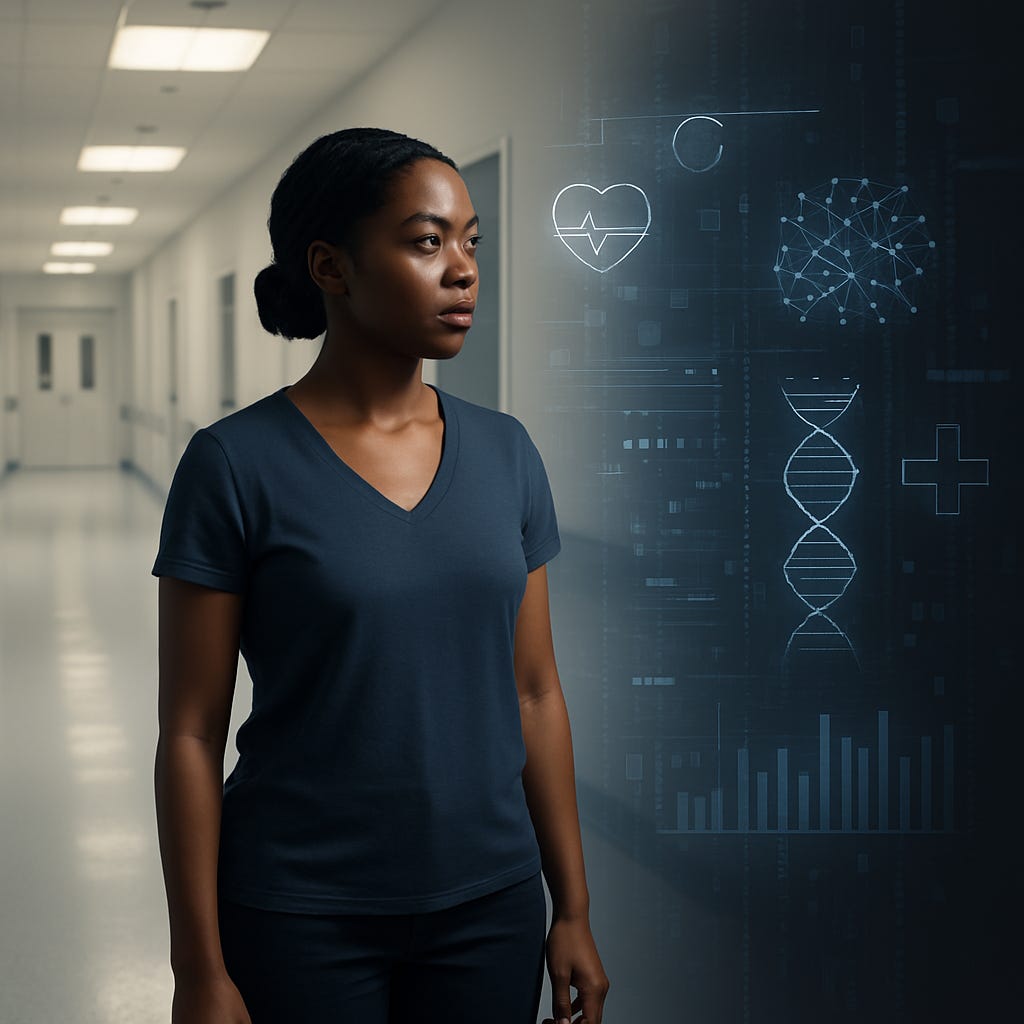
This is the crossroads we’re standing at. AI has the potential to become the most powerful diagnostic tool that medicine has ever seen. Still, if we're not intentional, it could also become the most impersonal perpetuator of systemic medical bias.
So what would it take to ensure that AI doesn’t inherit our worst assumptions? Can we build algorithms that actually see us, especially when the healthcare system never did?
This series will explore the following questions: the dangers of training AI on biased data, the promise of transparency and fairness in algorithm design, and the broader cultural shifts needed to ensure that tech doesn't just reinforce the status quo; it helps dismantle it.
Because being heard shouldn’t be a privilege. It should be the baseline.
And maybe, with the right tools and the right values, it finally can be.
Next Up: Part II: Garbage In, Garbage Out: How AI Learns from the Broken Systems We're Trying to Fix
Back to the Beginning: Series Overview: “Trust, Bias, and the Algorithm: Rethinking AI in Women’s Healthcare”
Thanks @Rachel for highlighting the concern that AI trained on current data sets is likely to be "The most impersonal perpetuator of systemic medical biases". AI will need a flood of honest lived experiences to correct imbedded biases. We're all physical first so this means we will need to broadly engage in the use of apps and wearables to convert our physical lived experience into zeros and ones such that they are explorable by AI. Detailing the minutiae of our lives and maintaining privacy and control over these digital assets requires an upgraded trust framework such as The 3 Zone model I've outlined in various posts and the book "Wealthcare". Happy to help in any way I can.